Palliative care at home: implications of the Covid-19 pandemic and into the future
Covid-19 has had vast impacts on health and social care. This research focuses on the degree to which palliative care has moved to people’s own homes during the pandemic and the implications of this.
Data
Drawing on open data made available by National Records of Scotland, we analysed death records which indicated (a) the cause of death, and (b) whether that death occurred at ‘home and other non-institutions’ or elsewhere: largely hospitals and care homes. Most of those deaths indicated to be at ‘home and other non-institutions’ will have been in people’s own homes.
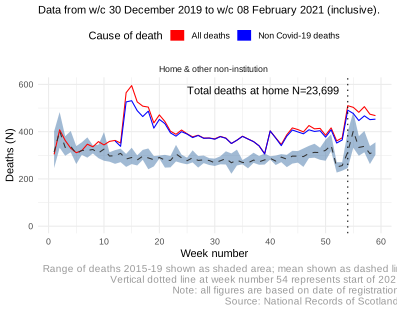
The following graph shows numbers of death occurring at ‘home and other non-institutions’ from the weeks prior to the pandemic to the early part of 2021 that were not Covid-19 related (blue line) and 'all cause' deaths (red line). It also shows deaths at home in previous years (2015-2019) for context.
Key Findings
- Numbers of people dying at home have increased since the early stages of the pandemic.
- During the first peak of the pandemic, some 600 deaths occurred at ‘home or other noninstitution’ in Scotland over a week, more than double than during a similar period in previous years.
- Most of those deaths indicated to have been at ‘home or other non-institution’ have been non-covid related with only a very small proportion (approx. 2%) having had indication of being associated with the virus.
- After the initial peak, virtually all deaths at home or other non-institutions have not been the result of covid.
- Numbers of deaths at ‘home or other non-institution’ have remained elevated throughout the course of the pandemic.
- A total of 16,976 home deaths were recorded since the start of the pandemic and the end of 2020, or a 43% increase over the same period in 2015-19.
Discussion: Future Trends and Implications for Community Care
The marked increase in deaths at home has notable implications for social care resources and community nursing. Care at the end of life is often demanding given the level of physical and psychological support involved, both to ensure a high level of palliative care, as well as to ensure family carers feel supported. The implications of this shift of deaths to the community will likely have been marked for those involved even though very few were directly Covid-19 related.
Various reasons are likely to explain the shift to dying at home. It may be that GPs will have been reluctant to transfer patients from home to hospital, recognising the shift in priorities of acute settings. People themselves may have preferred to remain at home whether in recognition of the pressures, that they would not be able to receive visitors, or to avoid risk of contracting the virus. The predominance of non-Covid deaths suggests that it may well have been decisions by health care professionals, including those in hospital settings.
A key question is what the implications of this shift in deaths will be into the future. Trends in home deaths have closely followed the peaks of all deaths from Covid-19. This would suggest deaths at home may well shift back to levels seen pre-pandemic. However, hospitals will be under pressure for a considerable period, given the backlog in routine work and impact of this last year on care staff. It is possible that this is a longer-term shift.
Understanding these trends in more detail can open-up discussion as to the future of palliative care and the role of hospitals, as well as the resource implications. Whilst this initial work has used open data that is aggregated, there is potential to use linked datasets to enable insights helpful to developing policy responses. We do not know about the circumstances of those who died at home, quality of care and support received (not only for those approaching the end of life but also their carers), or the impacts on health and social care workers in the community. These are questions which we at SCADR are looking to focus on.
We will also be continuing to monitor these trends and reporting these in our monthly blog, published at the start of each month on our website.
If you have any research questions or policy priorities related to this area or would like to collaborate with us, please get in touch by emailing scadr@ed.ac.uk.
This article was published on 03 Mar 2021